Let us start by presenting the sequence of odd numbers.
1,3,5,7,9,11,13,15….
Now let’s sum the first two terms of the sequence.
1+3=4
We now want to sum the first three terms of the sequence.
1+3+5=9
As you can see if we continue summing more and more terms of the sequence we get larger and larger perfect squares. This assertion may be formalized as 1+3+5+7…n =x^2 here n represents the nth odd number. The proof of this assertion is left to the avid reader of this blog.
There is more values of primes that make this set of finite polynomials( a1x^n+b1, a2x^n +b2, a3x^n+b3, …anx^n+bn ) generate more primes compared to another set of finite polynomials with the same amount of elements (a1x^n+c1, a2x^n +c2, a3x^n+c3, … anx^n+cn ) where (c1, c2 , c3, cn)< (b1, b2 , b3, bn). However, we must state some some necessary conditions for this in order for this to be true. The polynomials considered here must have positive integral coefficients and must not be factorable over the integers. The degrees of the polynomials considered here must be greater than zero. The pairwise coprimality of each element of the set of polynomial progression is necessary e.g GCD(a1,b1)=1, GCD(a2,b2)=1, … GCD(an,bn)=1(For the first set of polynomial progressions) The second set must also be pairwise coprime in a likewise manner. Here the italics indicate that the letters and numbers are subscripts. I also wonder which set produces more regular primes versus irregular primes i.e does (b1, b2 , b3, bn) produce more irregular primes than (c1, c2 , c3, cn) assuming that there is infinitely many regular primes implictly and also assuming (b1, b2 , b3, bn) > (c1, c2 , c3, cn) with the same conditions outlined above. Is the conjecture over the larger domain of the Gaussian Primes with also generalizations of regular and irregular primes? As always I welcome the readers to prove or disprove this conjecture or to extend this conjecture further if possible. Some sources for my conjecture will be displayed below.
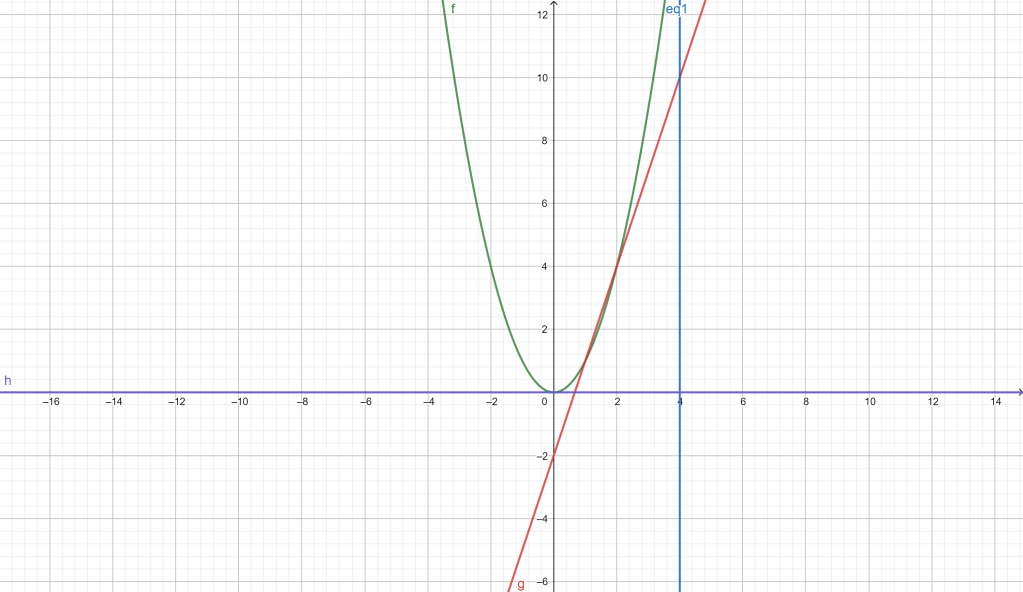
First, graph the quadratic polynomial, here I have graphed x^2.
Next, draw a vertical line to touch the tip of the curve, although this image does not show it touching the curve it does in fact do so, here I graphed x=4 for the vertical line
Now, draw a horizontal line that is equal to zero.
Next, find a tangent line for the curve, I picked 3x-2 as the tangent line,Evaluate the straight line’s gradient e.g find its derivative using y2-y1/x2-x1. This tangent line was found via trial and error but if you want a more accurate tangent line use the distance between two points formula at 0,0 for this case and then at the tip of the curve. The following link is attached if you don’t know or understand what it is.
Finally, to integrate where both the straight line and the vertical line is the triangle you want to integrate, find the length of the height of the triangle and the length of the base of the triangle, now find the area using base times height divided by two.
Now we have successfully differentiated and integrated the quadratic polynomial presented to us. By the way, this is my own method of evaluation, feel free to use it but please do attribute it to me or my blog. Down below is how it should look.
a^b is always transcendental when (a,b) are real transcendental numbers.
A transcendental number is a number that is not the solution of a polynomial with integer coefficients.
An example of a provably transcendental number follows.
One such number that is transcendental by this is e^pi.
The transcendence of e^pi was proven as a corollary of the Gelfond-Schneider Theorem so its transcendence has been established independently of this conjecture.
Also is the P-adic varient of this conjecture true?
Between P^n and (P+2x)^n where n is equal to the difference of P+2x and P where P and P+2x are both prime , m being greater than zero there is at least P+2x – P primes.
For example suppose P=3 then x=1 and n=2.
Then 3, 3+2(1)=3,5
5-3=2
Now we will find that they are at least two such primes.
There exists infinitely many triangular numbers that are prime.
The triangular numbers are defined by adding n positive integers together. For example the first triangular number is 1 the next one is 3. The one after that is 6. So the triangular numbers are defined as 0+1=1
 My Mathematics work and other extraneous diversions